
Have you ever wondered how you can integrate the information in the ACTFL Proficiency Guidelines – 2024 (Guidelines) and the ACTFL Performance Descriptors into your Dual Language Education (DLE) or Dual Language Immersion (DLI) curriculum? Are you trying to meet DLE standards and also want to ensure you’re targeting performance descriptors at specific language proficiency levels?
「ACTFL言語運用能力ガイドライン2024(以下、ガイドライン)」と「ACTFLパフォーマンス記述文(Performance Descriptors)」の情報を、二言語教育(DLE)や二言語イマージョン(DLI)のカリキュラムにどのように統合できるか、考えたことはありますか?DLEの基準を満たしながら、同時に特定の言語運用能力レベルにおける記述文を目標に設定しようと試行錯誤していませんか?
Start with the End in Mind(「ゴール」を念頭に置いて始める)
Consider mapping out the standards you are targeting in a lesson or unit. Based on the theory of backward design (Wiggins & McTighe, 2005), start with the end in mind.
まず、レッスンや単元で目標とする基準のマッピングを検討しましょう。バックワード・デザイン(逆向き設計:Wiggins & McTighe, 2005)の理論に基づき、「ゴール」を念頭に置いて開始します。
1. What is the desired output or evidence of learning you want from your students?
2. From there, consider what learning outcomes will help you achieve that target.
3. Finally, build the learning activities and assessments that will guide your students along the path to the desired outcomes.
1. 学生に期待する「アウトプット」や「学習の証拠(エビデンス)」は何ですか?
2. そこから逆算して、その目標達成に役立つ「学習成果(ラーニング・アウトカム)」を検討します。
3. 最後に、学生を望ましい成果へと導くための「学習アクティビティ」と「アセスメント(評価)」を構築します。
If you are working to align your program with the Guidelines and a proficiency focus generally, keep that alignment across the board – in your learning objectives, assessments (e.g., ACTFL Assessment of Performance toward Proficiency in Languages, or AAPPL), learning activities, professional development, etc.
プログラムをガイドラインや、一般的な運用能力重視の考え方に適応させようとするなら、学習目標、評価(例:AAPPL)、学習アクティビティ、専門能力開発など、あらゆる局面でその一貫性を維持するようにしてください。
As you do this planning, consider what modes of communication will be part of your learning activities. Here’s a sample scope and sequence that could be for a grade 9 DLE/DLI Language Arts class, illustrating how NCSSFL/ACTFL can-do statements and related performance tasks align DLE standards.
計画を立てる際は、どのアクティビティにどのような「コミュニケーション・モード」が含まれるかを考慮します。以下は、中学3年生のDLE/DLI言語芸術クラスを想定した学習範囲と順序の例です。NCSSFL/ACTFLの「Can-doステートメント」と関連するパフォーマンス課題が、どのようにDLE基準と合致するかを示しています。
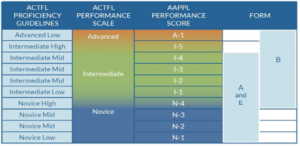
Image: © ACTFL. Use with permission. https://www.actfl.org/assessments/k-12-assessments/aappl/aappl-scores-reporting
Example: Language Arts (L1 & L2)(例:言語芸術 (第一言語 & 第二言語))
Evidence of Learning: AAPPL score of I-2 to I-4 (Intermediate Mid)
ACTFL Modes: Interpersonal, Interpretive, Presentational
Standards Alignment: Biliteracy development, use of authentic texts, cross-linguistic connections.
学習のエビデンス:AAPPLスコア I-2 〜 I-4(中級の中:Intermediate Mid)
ACTFLモード:対人的、解釈的、発表的
基準の整合性:バイリテラシーの育成、生教材の使用、言語横断的なつながり。
| Thematic Unit | Sample Can-Do Statements (L1 & L2) |
Performance Tasks |
|---|---|---|
| First quarter: Identity & Community | I can describe myself and my family. I can talk about very familiar things in my community. |
Write several sentences about yourself in both languages. Present a basic bilingual community map. |
| Second quarter: Heroes & Role Models | I can describe someone I admire. I can explain in simple sentences what they did. |
Create a bilingual biography poster and discuss it with your partner. |
| Third quarter: Cultural Stories & Legends | I can retell a short story. I can compare main ideas from two legends or folktales. |
Compare simple folktales from each culture in both languages. |
| Fourth quarter: Our Changing World (Environment & Society) | I can summarize short articles. I can share basic opinions and advice on a variety of familiar topics. |
Write and present a short persuasive speech in both languages. |
| テーマ・ユニット | Can-Doステートメント (第一言語 & 第二言語) |
パフォーマンス課題 |
|---|---|---|
| 第1四半期:アイデンティティとコミュニティ | ・自分自身や家族について説明できる。 ・自分のコミュニティにある非常に身近なものについて話すことができる。 |
両方の言語で自分自身について数文作成する。基本的なバイリンガル・コミュニティ・マップを提示する。 |
| 第2四半期:ヒーローとロールモデル | ・自分が尊敬する人について説明できる。 ・その人が何をしたかを簡単な文章で説明できる。 |
二言語による伝記ポスターを作成し、パートナーとそれについて話し合う。 |
| 第3四半期:文化的な物語と伝説 | ・短い物語を自分の言葉で話す(リテール)ことができる。 ・2つの伝説や民話から主要なアイデアを比較できる。 |
それぞれの文化にある簡単な民話を、両方の言語で比較する。 |
| 第4四半期:変わりゆく世界(環境と社会) | ・短い記事を要約できる。 ・さまざまな身近なトピックについて、基本的な意見やアドバイスを共有できる。 |
両方の言語で短い説得力のあるスピーチを執筆し、発表する。 |
Targeted Outcomes and Content Alignment Make Powerful Programs(目標とする成果とコンテンツの整合性:強力なプログラムの構築)
In this example, Intermediate Mid is the desired goal. As the school year advances, the can-do statements begin to include Advanced can-do statements. By using both Intermediate and Advanced can-do statements, students practice and work to develop language at a higher level (and then are assessed at the Intermediate level).
この例では、「中級中」が最終目標です。学年が進むにつれ、Can-doステートメントには「上級」の内容が含まれ始めます。「中級」と「上級」両方のCan-doステートメントを使用することで、学生はより高いレベルの言語習得を目指して練習・取り組みを行います。(その上で「中級」レベルでの評価を受けます。)
With evidence of learning defined and a targeted scope and sequence, the process of building learning activities and selecting assessments becomes much more focused. And with both Guidelines and DLE Guiding Principles in mind, you ensure that your immersion program is developing both content and language mastery in your learners. ACTFL assessments, such as the AAPPL, can improve your assessment strategies by using content that is age- and proficiency-level appropriate and tightly aligned to the Guidelines. Detailed AAPPL reporting can help you identify specific skills where learners may need more support or practice. Language Testing International (LTI), the exclusive licensee of ACTFL, provides robust AAPPL reporting features and a dedicated support staff to help you digest test data and identify actionable steps based on that data.
学習のエビデンスが定義され、目標とする学習範囲と順序が定まれば、学習アクティビティの構築や評価方法の選択プロセスは、より焦点が絞られたものになります。ガイドラインと「DLE指導原則」の両方を念頭に置くことで、イマージョン・プログラムによって学習者の「コンテンツの習熟」と「言語の習熟」の両方を確実に育成できるようになります。AAPPLなどのACTFLアセスメントは、年齢や運用能力レベルに適切で、かつガイドラインに密接に準拠した内容を使用しており、評価戦略を改善することができます。AAPPLの詳細なレポート機能は、学習者がより多くのサポートや練習を必要とする特定のスキルを特定するのに役立ちます。ACTFLの独占ライセンシーであるLanguage Testing International (LTI) は、強力なAAPPLレポート機能と専任のサポートスタッフを提供し、テストデータの理解や、データに基づいた実行可能な次なるステップの特定を支援します。
Further, ACTFL’s Educator Resources, professional learning opportunities, and publications can help you identify realistic language goals in your DLE/DLI programs. With a proficiency focus in your DLI/DLE programs, students will develop language competency beyond just content vocabulary and will be better positioned to leverage their language skills in real-world contexts.
さらに、ACTFLの教育者向けリソース、専門学習の機会、および出版物は、DLE/DLIプログラムにおいて現実的な言語目標を設定する助けとなります。DLI/DLEプログラムで運用能力を重視することにより、学生は単なるコンテンツ語彙を超えた言語能力を身につけ、実社会の文脈で自分の語学力を活用できるより良いポジションを得ることができるでしょう。